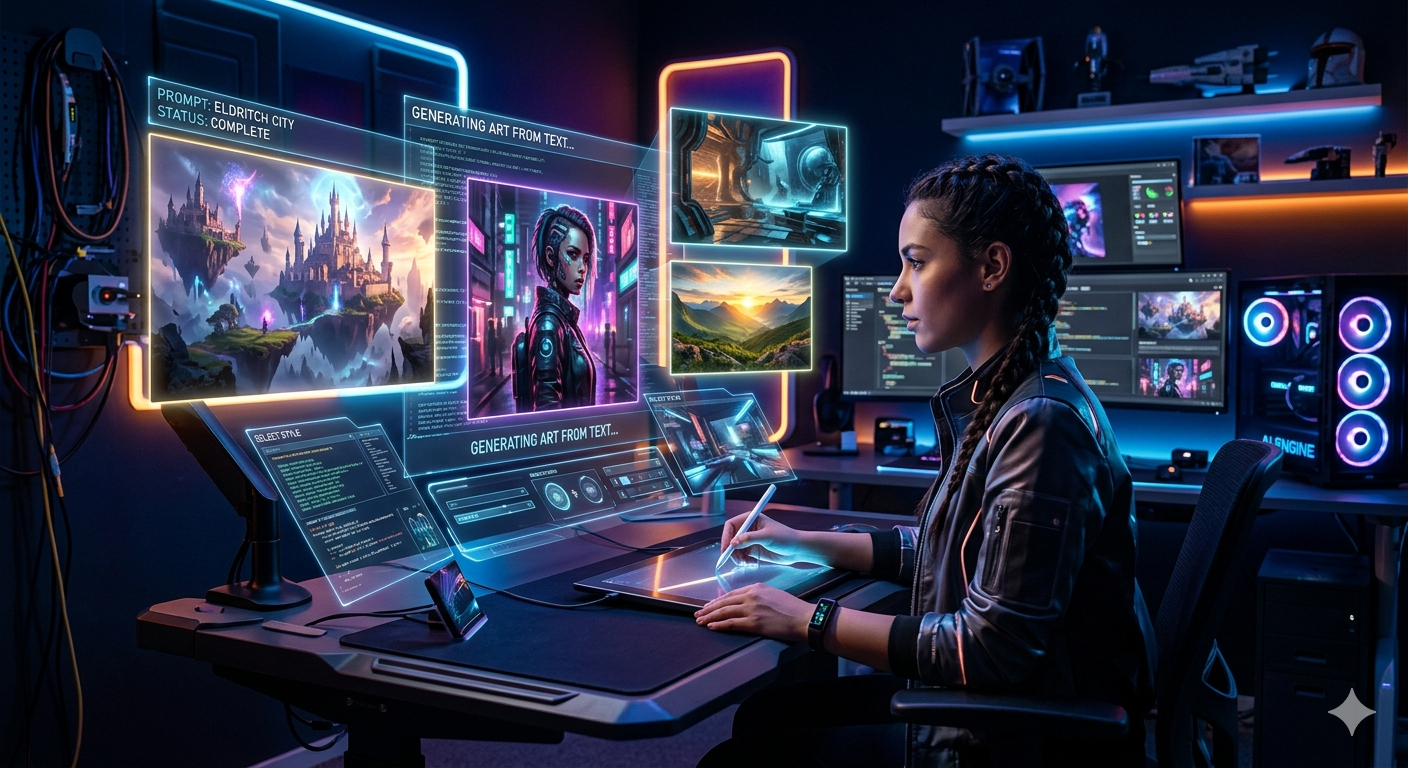
AI image generation has completely changed how designers, creators, marketers, and even beginners produce visuals. Instead of needing advanced drawing skills or expensive tools, anyone can now create stunning artwork using ai image prompts. These prompts act as instructions for AI tools like Midjourney, DALL·E, or Stable Diffusion, guiding them to generate highly detailed and creative images in seconds.
However, the real difference between average results and professional-quality AI art lies in how you write your prompts. A poorly written prompt gives random or low-quality results, while a well-structured prompt can produce cinematic, realistic, or highly artistic images that look like they were created by professional designers.
In this guide, we will explore how ai image prompts work, how to structure them properly, and how you can use them to generate amazing artwork across different styles and industries.
1. What Are AI Image Prompts and How Do They Work?
AI image prompts are text instructions that you provide to an AI image generator. These instructions describe what you want the AI to create. The more detailed and structured your prompt is, the better the output you get.
For example, instead of writing “a city at night,” a strong prompt would be:
“A futuristic cyberpunk city at night, glowing neon lights, flying cars, rainy atmosphere, ultra-detailed, cinematic lighting, 8K resolution.”
The AI interprets each part of the prompt—objects, style, lighting, mood, and quality—and combines them into a single image.
Modern AI tools have been trained on millions of images, so they understand artistic styles, camera settings, and even emotional tones. This is why ai image prompts have become such a powerful tool for creators, allowing them to turn imagination into visuals instantly.
2. Why AI Image Prompts Are Important for Creators
The importance of ai image prompts goes far beyond simple image generation. They are now a core skill in digital creativity, marketing, and content creation.
For designers, prompts reduce the time needed to create concepts. Instead of sketching multiple drafts, they can generate variations in seconds. For marketers, AI-generated visuals help create ad creatives, social media posts, and product visuals without hiring expensive design teams.
Content creators and bloggers also benefit by generating unique featured images that improve engagement and SEO performance.
Another major advantage is scalability. With the right prompts, you can generate hundreds of image variations quickly, test different styles, and choose the best-performing visuals.
In short, mastering ai image prompts means unlocking a new level of creative freedom and productivity.
3. Structure of High-Quality AI Image Prompts
A good AI prompt is not just a sentence—it is a structured instruction. The best ai image prompts usually follow a specific format that includes multiple layers of detail.
A strong structure includes:
- Subject (what the image is about)
- Style (realistic, anime, 3D, watercolor, etc.)
- Environment (background or setting)
- Lighting (natural, cinematic, neon, soft light)
- Details (textures, mood, objects)
- Quality tags (4K, ultra-detailed, high resolution)
For example:
“A warrior standing on a mountain cliff, cinematic fantasy style, dramatic sunset lighting, wind blowing cape, ultra-detailed armor, 8K resolution, highly realistic.”
This structured approach helps AI understand exactly what you want, leading to much better results compared to vague descriptions.
4. Types of AI Image Prompts You Can Use
There are many different styles of ai image prompts, depending on the type of artwork you want to create.
Realistic prompts are used for lifelike images such as portraits, landscapes, or product photography. These often include camera terms like “DSLR,” “bokeh,” or “depth of field.”
Fantasy prompts are used for creative worlds like dragons, castles, and magical scenes. These often include dramatic lighting and imaginative elements.
Cyberpunk and sci-fi prompts focus on futuristic cities, robots, neon environments, and advanced technology.
Anime-style prompts are widely used for character design, especially in gaming and storytelling content.
Minimalist prompts focus on clean, simple designs with limited elements and soft colors.
Each type of prompt requires different wording techniques, but the core principle remains the same: clarity and detail improve output quality.
5. Common Mistakes People Make in AI Image Prompts
Many beginners struggle with ai image prompts because they make simple but critical mistakes that reduce image quality.
One common mistake is being too vague. For example, writing “a beautiful landscape” does not give the AI enough detail to generate a strong image.
Another mistake is overloading the prompt with too many conflicting ideas. When a prompt is too complex or inconsistent, the AI produces messy or unclear results.
Some users also ignore style and lighting details, which are essential for professional-looking images. Without them, images often look flat or generic.
Another issue is repetition. Repeating the same words does not improve results and can confuse the AI model.
Avoiding these mistakes can instantly improve your AI-generated artwork quality.
6. Advanced Techniques for Better AI Image Prompts
Once you understand the basics, you can start using advanced techniques to improve your ai image prompts even further.
One powerful technique is using “weighting” in prompts, where you emphasize certain elements more than others. This helps the AI prioritize important parts of the image.
Another technique is style blending, where you combine multiple art styles like “oil painting + cyberpunk + realism” to create unique visuals.
You can also use camera language such as “wide-angle shot,” “close-up portrait,” or “aerial view” to control perspective.
Adding emotional tone is another advanced trick. Words like “mysterious,” “dramatic,” or “peaceful” help shape the mood of the final image.
These advanced methods turn simple prompts into professional-level creative tools.
7. Best Use Cases of AI Image Prompts in Real Life
The use of ai image prompts is growing rapidly across different industries.
In marketing, businesses use AI-generated visuals for ads, branding, and social media campaigns. This reduces costs and speeds up content production.
In gaming, developers use AI prompts to create concept art for characters, environments, and storyboards.
In blogging and SEO, creators generate custom featured images that improve click-through rates and user engagement.
E-commerce stores use AI visuals to create product mockups and lifestyle images without expensive photoshoots.
Even education and storytelling platforms use AI images to make learning more interactive and visually appealing.
This shows that AI prompts are not just a trend—they are becoming a core part of digital content creation.
8. Tools That Work Best with AI Image Prompts
Several powerful tools support ai image prompts, each with its own strengths.
Midjourney is known for highly artistic and cinematic results, making it popular among designers and creators.
DALL·E focuses on realistic and versatile image generation, ideal for general use and marketing.
Stable Diffusion is open-source and highly customizable, making it popular among developers and advanced users.
Adobe Firefly integrates AI image generation into professional design workflows.
Each tool interprets prompts differently, so learning how to adjust your ai image prompts for each platform is important for best results.
9. Future of AI Image Prompts and Digital Creativity
The future of ai image prompts is extremely promising. As AI models continue to evolve, prompt engineering will become an essential digital skill.
Soon, AI tools will understand more complex instructions, including emotions, storytelling, and even real-time editing based on voice commands.
We may also see integration with 3D modeling, video generation, and virtual reality environments, where prompts will create entire immersive worlds instead of just static images.
This means creators who master prompt writing today will have a huge advantage in the future digital economy.
Conclusion
AI image prompts are more than just text instructions—they are a gateway to unlimited creativity. Whether you are a designer, marketer, content creator, or beginner, learning how to structure and refine prompts can dramatically improve your results.
By understanding prompt structure, avoiding common mistakes, and using advanced techniques, you can create stunning, professional-quality artwork in seconds.
As AI technology continues to grow, the ability to write powerful prompts will become one of the most valuable creative skills of the digital era.